Quick summary: Will Larson, CTO of Imprint, merged over 100 pull requests to production in one week by removing bottleneck after bottleneck in his development loop, not just by running more agents. His most important finding is that the problem was not the speed of code review but producing pull requests that are easy to approve. If you use coding agents on your own or in a small team, three things are worth learning: verification files, consistent context, and a way to triage open work.
On November 22, 2026, Will Larson published Shipping 100+ PRs to production in a week. He is the CTO of Imprint, previously worked at Stripe and Uber, and wrote Staff Engineer and An Elegant Puzzle. In the week starting November 9, Larson merged 115 pull requests. Take his best seven consecutive days instead and the number reaches 170. Larson jokes that vanity made him pick the best seven-day window over the calendar week, so he admits he made the number look a little better.
Seeing that number, your first reaction might be to ask how many agents he runs, which tools he uses, and how to raise your own pull request count. But after reading the post closely, along with three of the related posts Larson links, I think the lesson is somewhere else: every time he cleared one bottleneck, he ran into a new one. This article walks through that chain of changes and keeps what Larson reports at Imprint apart from what I think you can take home to one agent and one repo.
How did Will Larson merge 100 PRs in a week?
Larson reached more than 100 pull requests a week after almost a year of steady changes to his development loop. Most pull requests in the peak period were written with fleet, Imprint's internal cloud agent harness. But fleet is only one of the ten steps he describes.
Of the 170 pull requests in his best seven days:
- 17 nuanced, UX-heavy pull requests were written with a harness (the layer that drives an agent's behavior) running on his laptop.
- 153 pull requests were written with
fleet, Imprint's internal cloud harness.
About 150 pull requests were changes to production systems, continuously deployed but not necessarily released to users. The other 20 or so were skills (reusable instruction packs for a specific job) and internal tools.
The phrase "deployed but not necessarily released" matters. A change that is in production behind a feature flag, a switch that turns a feature on or off, has not necessarily reached any user.
Imprint is also not a greenfield experiment. It is a six-year-old fintech company that was not built from scratch as AI-native. According to Larson, its software affects members' access to credit, their security, and partners' revenue. Imprint has to retrofit its existing systems and processes rather than rebuild them.
So what do 170 pull requests prove?
In my view, the number shows that Larson built a way of working that lets a large volume of changes flow through the system. It does not answer the other questions: How hard were the changes? What was their quality? Which ones reached users? What does it cost to check and maintain them?
In his post on small-change, published October 17, 2026, before he passed 100 pull requests a week, Larson also reports incidents down 42% and critical incidents down 78% half over half. These are internal numbers he reports himself, not independent measurements. They also do not prove that the process changes caused the drop.
Larson does not treat the pull request count as a productivity measure in itself. To understand the result, you have to look at what changed in his development loop.
The same loop, a new bottleneck
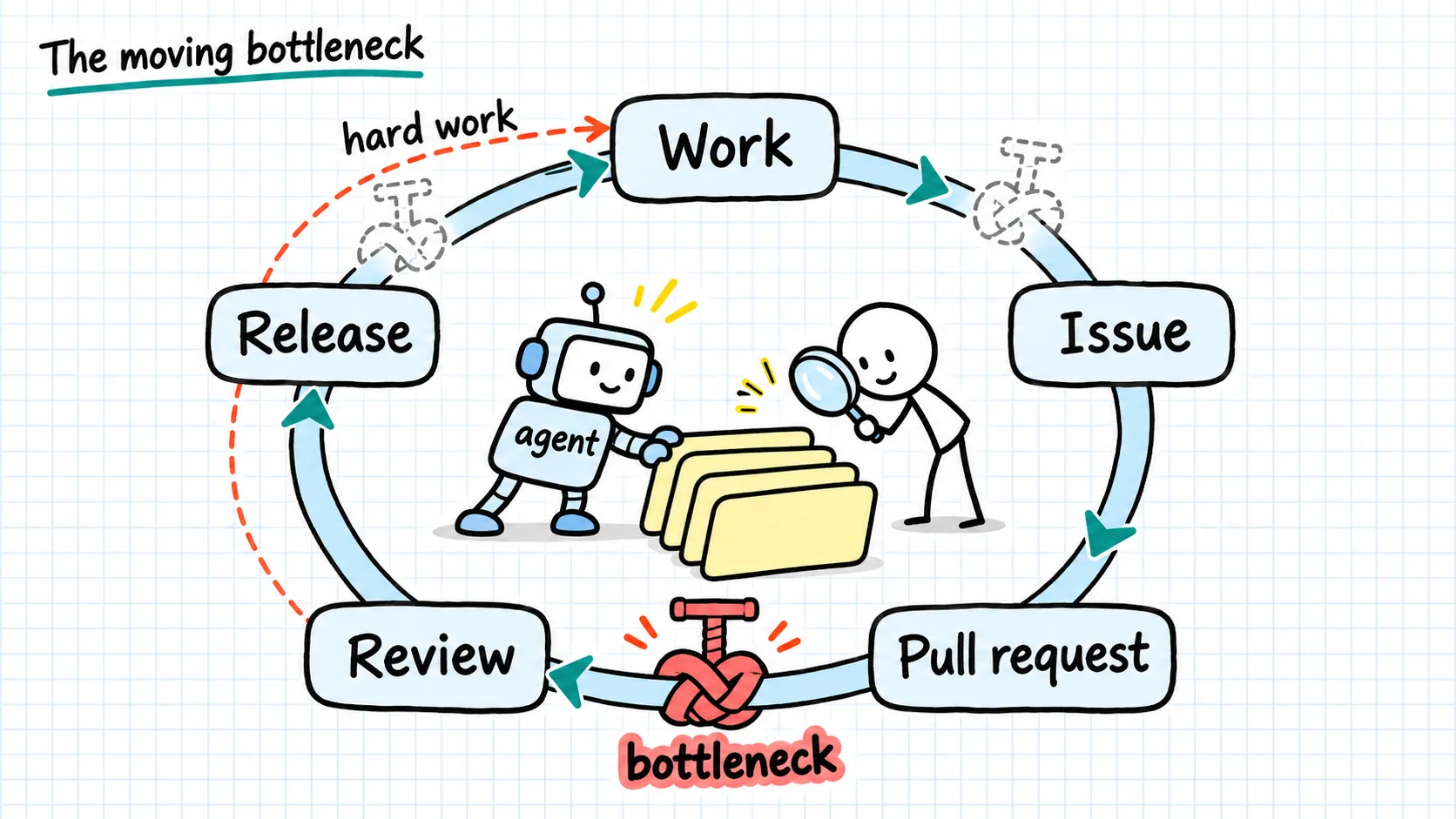
Larson did not start by replacing the whole engineering process with AI. He kept optimizing the familiar loop: there is work to do, it becomes a structured issue, then a pull request, then a review, then the change reaches production.
The difference is that agents, programs that can call tools and repeat steps on their own to finish a task, made some steps that used to take a lot of effort much faster. Once a step stops holding work back, the limit at the next step becomes visible.
Larson describes going from about 5 to 10 pull requests a week, to 20, to 40, then to 80 to 100. Each jump came from optimizing a different part of the loop.
Here are the ten steps he describes, in the order of the original post.
| When | Bottleneck | How Larson and Imprint removed it |
|---|---|---|
| December 2025 and January 2026 | Slow deployment and release | Modernized CI/CD (Continuous Integration/Continuous Delivery) and used feature flags to separate deployment from turning features on |
| February | Context full of wrong information | Cleaned up old documents, deleted wrong ones, and moved more configuration and engineering knowledge into the repo so agents see it consistently |
| June | No structured issues | Moved from Jira to Linear, one place to log work from the UI, Slack, and agents |
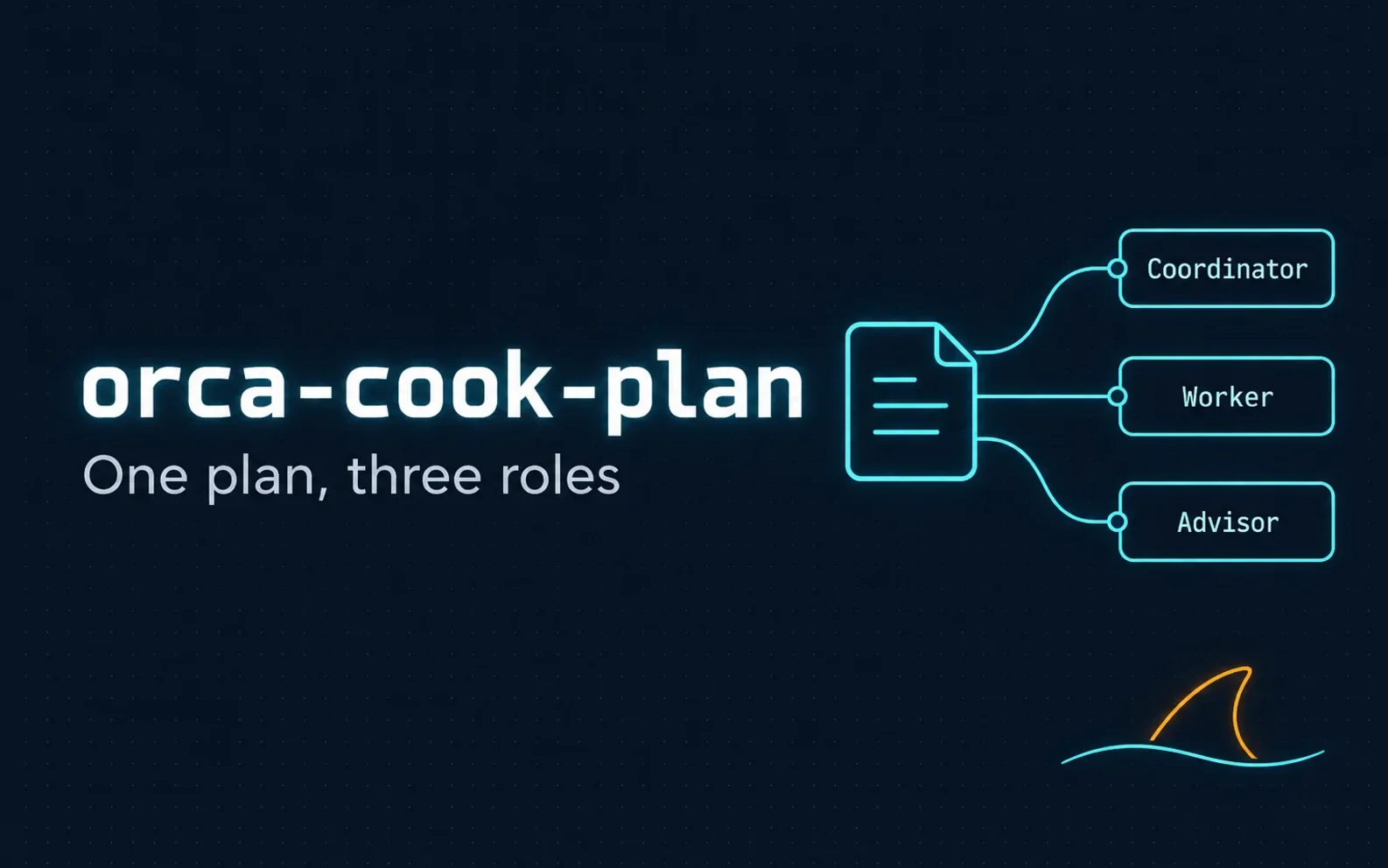
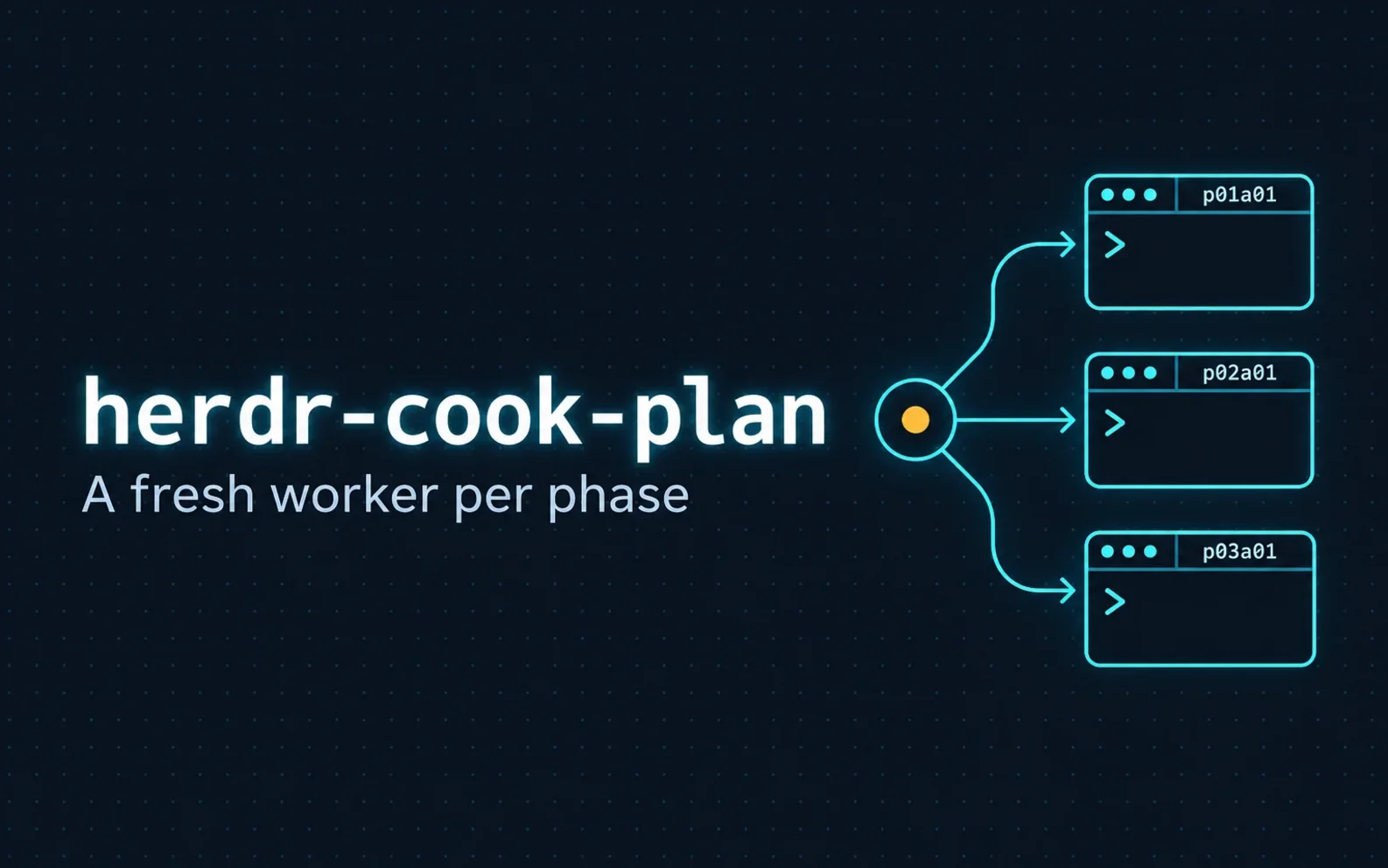
| July to October | Running and tracking parallel work on laptops did not scale | Built fleet, so agents run in the cloud without a laptop, run many tasks in parallel, have MCP (Model Context Protocol) servers and tools by default, and react to events instead of polling |
| September | Configuration still needed people to check and update it by hand | Built an internal MCP so agents can read configuration values and propose changes, while updates are still approved in the UI by a person with the right role and context |
| October | Slow code review | Tried small-change and let some changes made by the cloud harness be approved by a single person |
| October | Pull requests hard to approve because they lacked verification evidence | Adopted verification files and parts of the pstack skill set (covered below) |
| October to November | Ran out of easy work that had been logged as issues | Added maintenance loops, a pattern that proactively finds work, and work generated from events |
| November | Too much work needing someone to watch it | Built the /my-open-work skill to triage, recover, and route open work |
| November onward | The remaining work keeps getting harder | Trying the Explorer pattern, where a small group builds first and syncs with others later (covered below) |
One detail I want to stress: CI/CD came before fleet, before running many agents, and before any system that finds work on its own.
Larson put the deployment and release foundation first. Only then did he clean up context, organize issues, and scale out parallel work.
If you add agents while every pull request still waits for a manual deploy, the backlog just moves from writing code to deploying it. Likewise, if agents keep reading wrong documents, more agents can produce more changes that need fixing, not necessarily more value.
In February, Imprint started feeding RFCs (technical design proposals) and PRDs (product requirement documents) into the agents' context and found that much of it was no longer accurate. Imprint cleaned up Notion, deleted documents that were wholly wrong, and moved more engineering information into the repo. One manager went further and added loops that update stale documents based on code changes.
Larson calls wrong documents and conflicting guidance context poison. The issue is not only how much information an agent can read. Outdated or contradictory information can push an agent toward a wrong decision from the start.
Once these steps improved, Larson hit a familiar-looking problem: code was produced quickly but approvals could not keep up. How he dealt with it led to the most interesting finding in the post.
The real bottleneck was not approval
Larson first thought code review was the bottleneck, then realized the bigger problem was pull requests that were not easy enough to approve. Instead of only cutting the number of reviewers, he worked on showing reviewers what the agent had checked and what it had missed.
First, why did he want faster code review?
In Speeding up code review with small-change, Larson says the median code review time grew from about 33 minutes two years earlier to about 77 minutes. More merged pull requests meant more pressure on review.
Imprint tried two mechanisms.
The first is small-change, which applies to a set of changes that meet safety criteria defined in advance. Eligibility does not depend on a label the author adds. CI decides it through a GitHub check that people cannot edit by hand.
A change has to meet requirements such as:
- Fewer than 1,000 changed lines.
- No p1 or p2 findings from the
ai-code-reviewbot. - The author has at least 10 merged pull requests in the affected service. If a change spans several services, the author has to qualify in all of them.
- It touches fewer than N distinct services or applications, where N is 1 in the frontend monorepo and 3 in the backend monorepo (a monorepo is one repo holding many services or applications).
- It is not in a shared library or in a path excluded by the
.small_changefile, for example a money movement service.
The review-small-change skill only approves when every check passes and the change stays away from sensitive topics such as payments and security. It has only two options: approve or ignore. It never leaves comments, to avoid what Larson calls meat proxy review, where reviewers just relay comments an agent generated.
Larson also puts responsibility at the system level. If a small-change causes an error, the fix belongs in automated code review, verification, CI/CD, or the harness, not in asking one reviewer to be more careful.
Early on, about 10% of changes qualified. Larson says it is too early to judge the results.
The second mechanism lets some pull requests made with the cloud harness be approved by a single person. According to the small-change post, fleet has its own evaluation to decide how many independent reviewers each change needs, and for changes judged safe that number can be one. According to the main post, about half of all changes now go through one of these two mechanisms.
But Larson admits that treating approval as the bottleneck was partly a misread.
He writes: "the bottleneck wasn't pull request approval, but instead generating approvable pull requests." In other words, the bottleneck was producing pull requests with enough quality and enough evidence for someone else to approve them.
What does a verification file change?
Picture a pull request written by an agent. The code looks reasonable and the automated checks pass, but you still wonder: Which checks did the agent run? Did it try the failure cases? Is anything unverified?
Without answers, the reviewer has to retrace the work. Writing code got faster, but confirming that it is correct did not necessarily get faster.
In Self-reinforcing quality / adopting verification pattern, Larson describes requiring every pull request to include a verifications/{pr_num}.md file.
The file records each step the harness took to verify the change, including what it could not verify. A pull request cannot move from draft to ready without it.
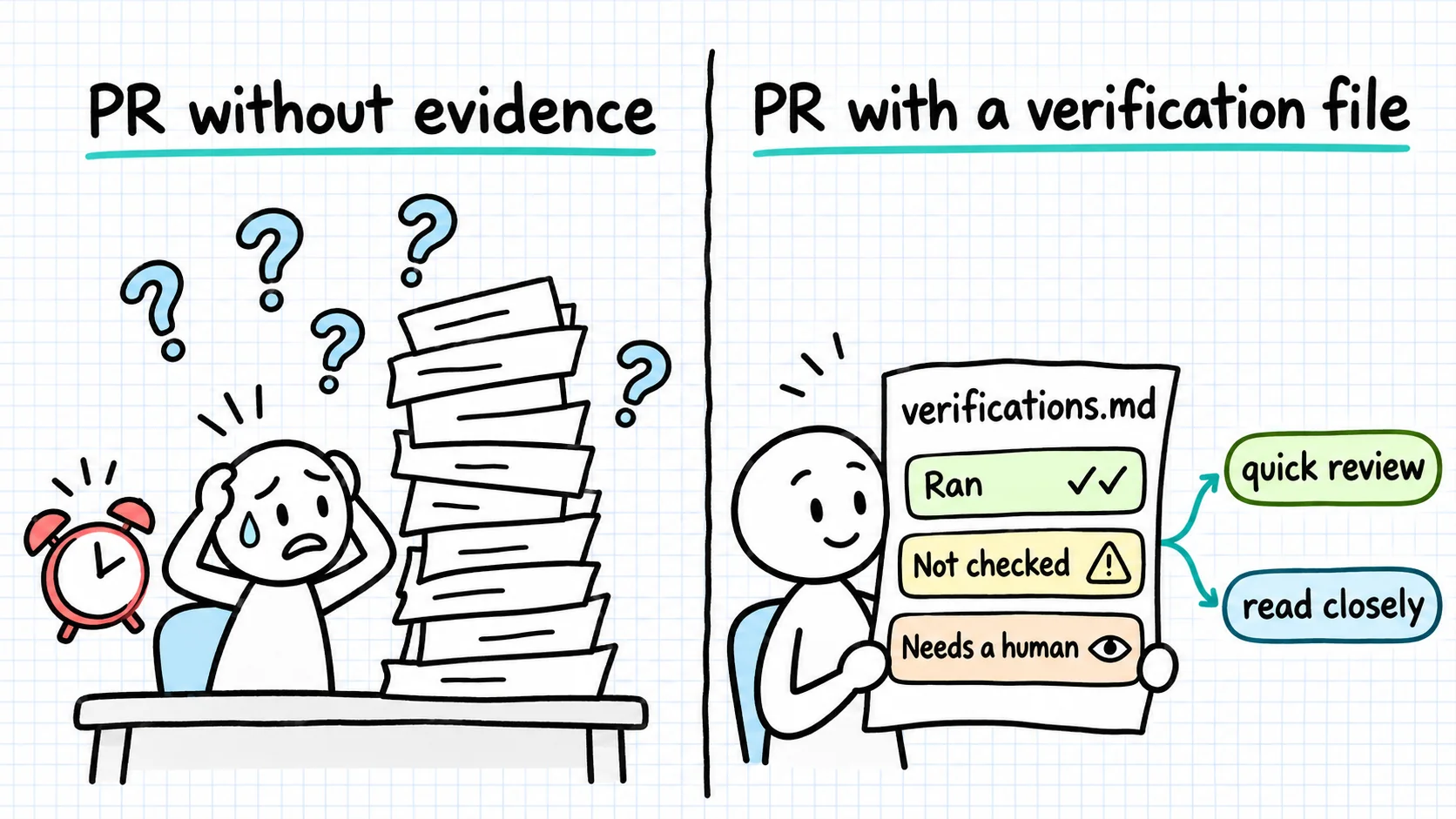
Larson explains that he had seen too many pull requests reach CI/CD with basic lint failures that could have been caught locally. The final result alone does not tell you what the agent did beforehand.
These days he mostly reviews verification files and uses them to decide whether a pull request needs a closer look.
This approach is tied to Lauren Tan's pstack, a skill set Imprint adopted in part, including its formal verification approach (using a specification or model to check behavior instead of only running it). I took the skill set apart in Inside pstack: how Lauren Tan's skills turn a coding agent into an engineering process.
A verification file does not prove the code is right, though. The agent can still check too little, misread the requirement, or record a result wrongly. The reviewer still has to judge whether the evidence is trustworthy and covers the risks that matter.
This links to a point in Cognitive surrender: keeping your judgment when agents do the work: a check only proves the part it covers.
The main value of a verification file is not more documentation. It makes verification something you can inspect. When the agent writes down what it could not check, you get a concrete list of what to improve in your tools or process next time.
When code is cheap, worthwhile work is scarce
Once creating and approving pull requests got faster, Larson hit a new limit: there was not enough clearly described easy work to hand to agents.
The company did not run out of work. Much valuable work had simply never been turned into structured issues.
For example, a feature has launched but its old feature flag still needs cleaning up. A new error appears in the logs. A security scanner reports a finding. Or a customer raises something on a support call that nobody has turned into engineering work.
In the past, engineers could see this work was worth doing, but the cost of tracking, investigating, and fixing it was too high for the immediate payoff.
Larson describes three ways to address it.
First, maintenance loops: maintain the verification steps, review recent launches, check for new errors, and prune feature flags that have stabilized.
Second, what he calls the software factory pattern. The harness looks at a problem proactively and proposes the next piece of work instead of waiting for an issue, much like a mid-level engineer who keeps an eye on an area.
Third, work generated from events. Security findings from static analysis, errors in logs, customer concerns, or signals from the distress tool, which lets a harness flag a problem for triage, can all become input for the harness.
As these mechanisms created more work, Larson hit another problem: too many things were running or waiting for someone.
/my-open-work removes the orchestration bottleneck
In November, Larson built the /my-open-work skill and runs it once or twice a day.
It goes through all his open work. Depending on the item, it can:
- Push the cloud harness to recover from a failure on its own.
- Schedule new work onto the harness from new issues.
- Step Larson through questions that need a human answer.
- Point out the changes he needs to review personally.
Larson calls this the last major breakthrough that took him past 100 merged pull requests a week.
What I like here is not a command that lists work. /my-open-work separates work that can move on without a person from work that really needs Larson's decision.
If every morning you open several agent sessions, read each one's state, find what is stuck, and decide what to do next, the time spent coordinating can eat the time saved by agents writing code faster.
In the article on critical thinking when working with agents, I covered Addy Osmani's idea of the orchestration tax: the gap between what agents produce and what you are comfortable putting your name on.
In my view, /my-open-work is a clear example of cutting that cost. Larson did not necessarily need more code-writing capacity. He needed to act as the coordinator less often for work that could already carry on by itself.
Once easy work flows, the bottleneck moves to hard work
Once easy work and coordination were handled better, the bottleneck moved to hard work: partner needs, member experience, and the particulars of fintech.
Larson is trying The Explorer Pattern: one person or a group of at most five builds a working version, keeps cross-team dependencies to a minimum early on, and only then reconciles the differences with other teams. The approach accepts that substantial rework may be needed. Changes ship to production behind a feature flag that is only on for internal staff.
This does not remove the risk of hard work. It shortens the path from an idea to a working version you can evaluate.
What can you take home, and what not?
You can learn Larson's way of finding and removing bottlenecks without copying Imprint's infrastructure. But you have to separate the principles that work in one repo from the changes that depend on company-wide authority, people, and systems.
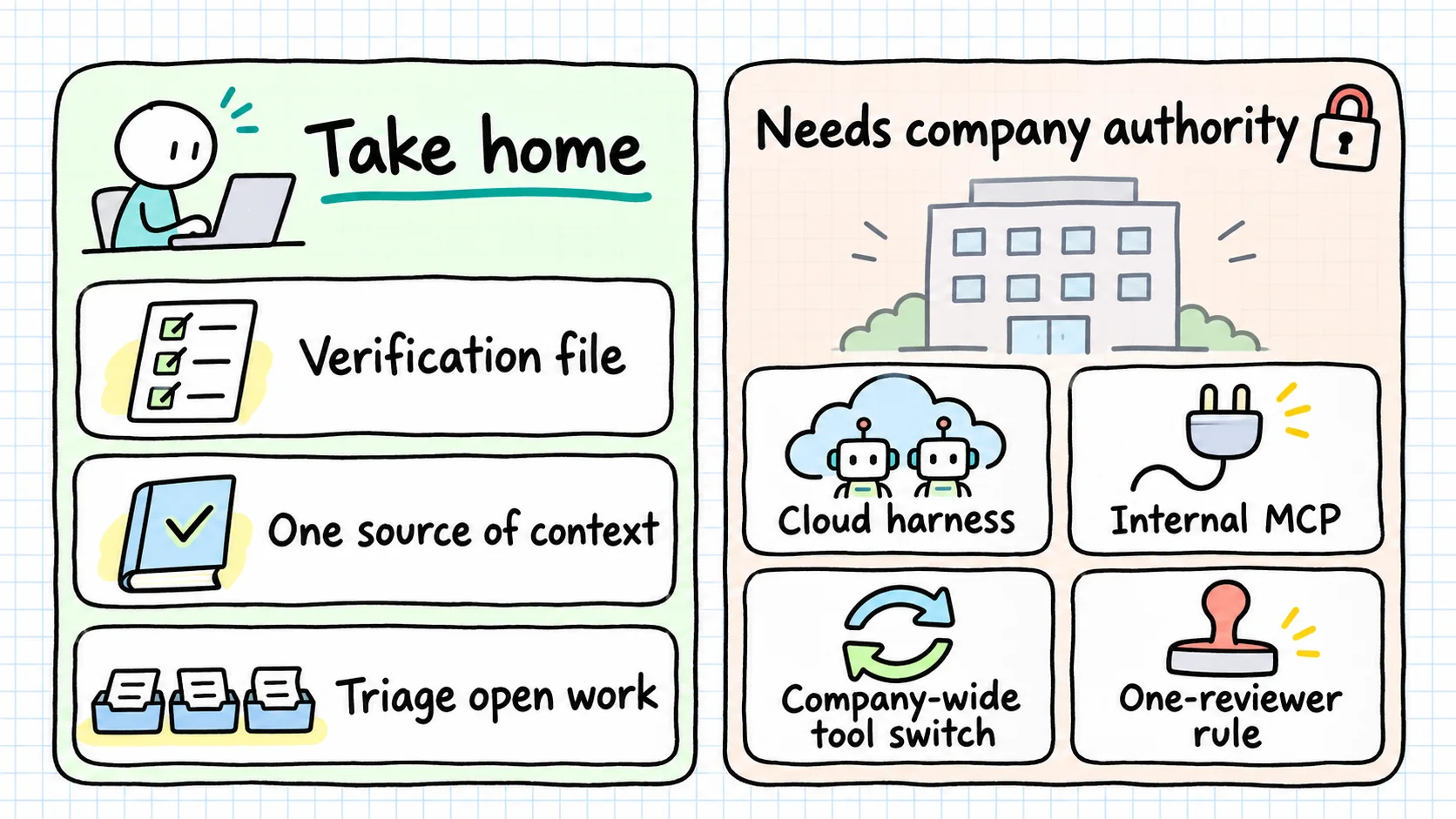
The three ideas I think are most worth taking home:
First, make verification results readable. Don't just ask an agent to fix the code and report done. Ask it to write down which checks it ran, what they returned, and what it could not verify. When you review a change, you then know where to look harder.
Second, keep one consistent source of guidance. Wrong documents, conflicting instructions, and outdated information should be fixed or removed, not kept in the context. The goal is for the agent to get one clear set of rules instead of guessing between versions.
Third, triage your open work. Instead of starting the day by opening more agent sessions, look at what is stuck, what can continue on its own, and what needs your decision. If you don't run much in parallel yet, a short list is enough, no custom skill needed.
One principle runs through all three: look at your current loop before you pick a tool to improve it. If most of your time goes into fixing requirements, more agents won't solve the right problem. If the code is ready but checking it takes you a long time, start with verification.
On the other hand, some parts of Larson's post don't transfer to a small team as is.
fleet is Imprint's internal infrastructure, built for a volume of work that outgrew tracking on laptops. Moving the whole company to Linear, changing code review rules, or building a system that creates issues from internal sources also takes authority and resources a single engineer in a repo does not have.
In my view, Larson's role makes a big difference when you read this post. As CTO, he can start or sponsor company-wide changes such as switching tools or setting code review rules, and choose which work to take on. An engineer building features usually cannot. The post describes the changes as "we" and thanks one manager by name, Andrew, for adding loops that update stale documentation in the knowledge base. So what is worth learning is how he finds bottlenecks and decides the order to tackle them, not the assumption that you can reshape the whole process the way he did.
In particular, don't read small-change as "small PRs can get a light review". Imprint has CI conditions, the author's track record, a cap on the number of services, and an exclusion list. A change of a few lines in a money movement service can still carry a lot of risk.
It also pays to keep the results in proportion.
The numbers in the post are self-reported by Larson, not an independent productivity measurement. He acknowledges that many of his pull requests are simpler than the work of the company's most senior engineers.
Even so, Larson sees merging 50 times the median (p50) weekly pull requests per Imprint engineer from a year earlier as a sign that the fundamentals of software development have changed. That is his reading of his own result.
My own reading is that, because the pull requests are not equally hard, this increase is better seen as a signal that the process and the capacity to handle work have changed, not as a like-for-like productivity comparison between a CTO and other engineers.
Larson also does not see enough evidence yet for claims that CI/CD or code review are dead. For software that needs correctness, security, compliance, and to stay understandable to people, as at Imprint, he keeps those controls.
In my view, this is what makes Larson's post more balanced than a productivity brag. He does not say every company should use the same process. He even writes that he suspects everything they do today will turn out wrong in the long run. Even the solutions that speed Imprint up today may not be the lasting way to work.
Where to start with one agent and one repo?
You don't need all ten of Larson's steps. Look at your last few sessions with an agent and find the step that makes you stop most often. Then pick one small change to try.
I suggest the three steps below. They are my own takeaways from Larson's posts, not a process I have tested or an Imprint rule.
Step 1: Ask for a verification file with every change
Instead of only asking the agent to finish the task, ask it to leave a short record of how it verified the work.
You can use this Markdown structure:
# Change verification

## Ran
- [Command or check]: [Actual result and evidence]
- [Command or check]: [Actual result and evidence]

## Could not verify
- [Case that was not checked]
- [Reason or missing condition]

## Needs human review
- [Decision or risk that needs a closer look]
This is my suggested template, not Imprint's original file.
This step assumes you work with branches and pull requests. For a personal repo or a small team, the lowest-friction option in my view is to paste the verification notes into the pull request description, as long as the reviewer can read the evidence. If you want a file like Larson's (verifications/{pr_num}.md), you need the pull request number, so open the pull request as a draft first and then create the file.
You can send the agent a request like this, or put it in your repo's instruction file so you don't retype it every session:
When you finish, run the repo's checks (test, lint, build).
Record them using the "Change verification" template: each command
you ran with its real output, pasting any error in full. If a command
could not run, list it under "Could not verify" with the reason.
Do not summarize that everything works.
This is also my own suggestion, not Imprint's prompt.
Ask the agent to record the commands it ran and their real output, not a one-line summary like "checked, everything works". If a check fails, keep the failure. If something was not run, it should say so.
After a few pull requests, look at which items keep showing up under "could not verify". That is where to consider adding tools, improving instructions, or changing how you hand out work.
Step 2: Clean up context before adding new instructions
Open the instruction files your tool loads into context, such as CLAUDE.md, AGENTS.md, your editor's rules folder, or README.md. Look for rules that conflict, outdated information, or several descriptions of the same thing.
My own example: CLAUDE.md tells the agent to run one set of checks while AGENTS.md describes a different one. If both end up in context, the agent has to resolve a conflict you should have settled first. This is an illustration of context poison, not an example Larson gives from Imprint.
Pick one canonical place for each group of rules. Other files can point to it instead of copying everything. Fix or remove wrong documents according to your repo's conventions.
The job is to remove wrong information, not to stuff in more context, so the agent does not decide based on stale facts.
Step 3: Triage open work every day
If you often hand several tasks to agents, take a short pass before starting anything new. A simple starting point is your repo's list of open pull requests and issues, plus any agent sessions still running.
Sort the work into three groups:
- The agent can continue: The requirement is clear, but it is waiting to rerun checks, fix an error, or finish a technical step.
- Needs my decision: It is missing a choice about scope, approach, or the expected result.
- Needs my review: The change has a result, but there is still risk or not enough evidence to accept it.
Start by sorting by hand. Only if this repeats and takes real time should you consider writing a skill like /my-open-work.
Don't automate coordination just because Larson did. With one agent and one repo, a clear task list is sometimes enough.
After the three steps, watch whether the bottleneck moves. If you used to spend time figuring out what the agent checked, and now that time shrinks but you deal with more unclear requirements, you have a signal about what to improve next.
If you want a ready-made PR flow script, a verification file template, a small-change review skill and a path for 1-5 person teams, I collected them in the guide Moving the PR bottleneck with coding agents.
Frequently asked questions
Three questions come up when you bring Larson's approach to a small project: what to measure, whether you need your own infrastructure, and how far you can cut code review effort.
Should pull requests per week be a KPI?
In my view, the pull request count should not be a productivity KPI on its own.
Larson calls merged pull requests per week "just a number that asks questions", a number that raises questions rather than answering them.
The count can help you notice that the pace of change is shifting. But you have to read it together with how hard the work was, the quality of verification, the errors that followed, and how much value the changes delivered.
Splitting one change into several smaller pull requests can raise the count without adding matching value. So pushing the number up can lead a team to optimize for the wrong goal.
Do you need a cloud harness like fleet?
No. The principles about context, verification files, and triaging work all apply to one agent running on your own machine.
fleet solved a problem Larson hit when parallel tasks and follow-up work outgrew what he could track on a laptop. If you have not hit that limit, you don't need similar infrastructure yet.
Add automation when there is a specific bottleneck to remove, not by building infrastructure first and then looking for work for it.
Can a small team use small-change?
You can learn the principle of sorting changes by risk, but don't copy Imprint's approval mechanism without equivalent guardrails.
A small team can start by deciding which kinds of changes are easy to verify, which need an experienced person to look closely, and which areas always need careful review.
Without CI checking the criteria, trustworthy verification evidence, or agreed responsibility when something breaks, cutting reviewers may just push the risk downstream.
Larson's small-change is a conditional mechanism, not a license to skip code review for every small pull request.
The lesson behind the 100 PRs
Larson is still working on three new bottlenecks: speeding up hard work, increasing verification coverage, and moving toward orchestration that does not need a person to run /my-open-work every morning. Even past 100 pull requests a week, he does not treat his development loop as a finished, optimized system.
What I want to keep from Will Larson's story is how he kept changing the question, not the target of 100 pull requests a week. When deployment and release were slow, he modernized CI/CD and used feature flags. When agents wrote faster, he fixed context and how work was organized. When pull requests were hard to approve, he added verification evidence. When too much was in flight, he improved coordination. When those stopped being the main limit, hard work became the new bottleneck.
If you use a coding agent every day, the question worth asking is: which step takes me the most time right now, and once it gets faster, which step will block me next? Larson himself is sure the bottleneck will keep moving.
Use this piece in your agent
Get an API keyCopy the text below and paste it into Claude Code, Codex or whichever agent you use. The agent reads the piece and checks it against the repo you have open.
Read "100 PRs a week: which bottlenecks did Will Larson remove?" on modernEngineer and apply it to this repo.
1. Call the content_get tool of the modernengineer MCP server with locale "en", slug "moving-bottleneck-100-prs-a-week". If MCP is not connected or access is refused, read the page https://modernengineer.dev/en/library/moving-bottleneck-100-prs-a-week instead.
2. Summarize the main steps of the piece and point out which apply to this repo.
3. Propose concrete changes and ask me before editing any file.
Connect MCP in Claude Code (once)
claude mcp add --transport http modernengineer \
  https://api.modernengineer.dev/mcp \
--header "Authorization: Bearer <API key>"This piece is open to everyone: without MCP, the agent can still read it straight from the link.
- Version
- v1.0.0
- Updated
- 26/11/2026
- Licence
- All rights reserved
- Slug
- moving-bottleneck-100-prs-a-week