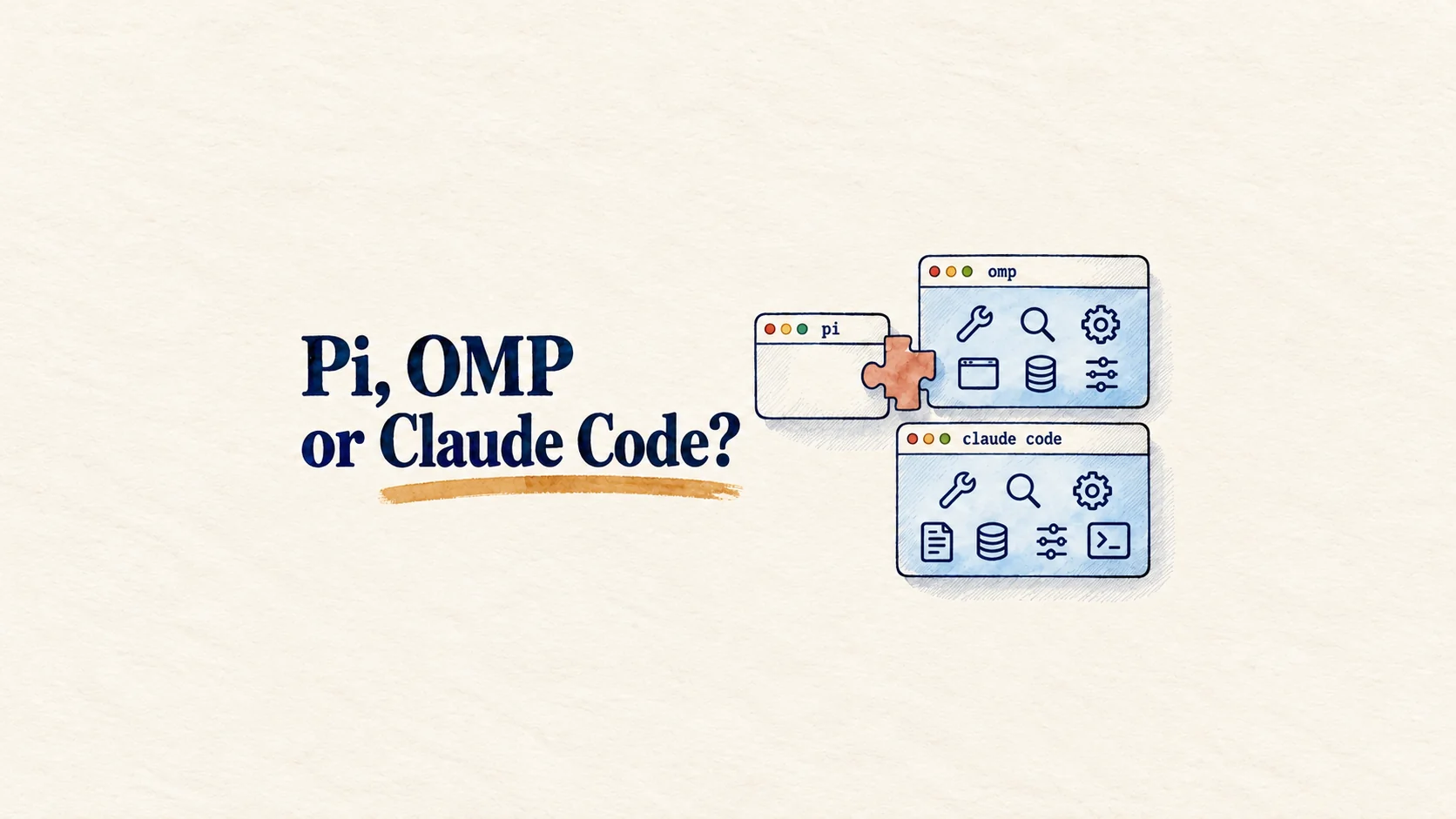
Quick summary: Advisor in Oh-my-pi (OMP) is a reviewer model that runs in the background for the whole session, with its own requests and context. It sends findings at three levels,
nit,concern, andblocker, and each level enters the main loop in a different way. Claude Code's Advisor is a one-off consultation inside the generation, and the model decides when to call it. AgentKit asks at checkpoints with an evidence packet (--advice) or interviews you when the brief is still vague (ak-advise). Pick by when you need the second opinion.
Disclosure: I maintain AgentKit and have an affiliate relationship with it: the AgentKit link in this post is an affiliate link; buying through it gets you 30% off. On OMP I am an independent researcher, with no commercial relationship and no role on the development team.
Note: the current AgentKit beta (since 3.0.0-beta.35, October 21, 2026) changed skill names from ak:<name> to ak-<name>, and the commands in this post use the new names: Claude Code calls /ak-plan, Codex calls $ak-plan. On an older version, swap ak- back to ak: to get the matching command.
Version: OMP behavior in this guide follows OMP v18.0.11, checked against the docs and source of that release. Where a newer release changed something, I note it right under the relevant config. The Claude Code and AgentKit sections follow their own docs.
I treat the Advisor as a second review loop, not a side model
A one-off consultation only judges a snapshot at the moment you ask. The OMP Advisor follows the sequence of changes in a session, so it can see a trajectory: the main agent repeating a mistake, a constraint slowly being forgotten, or an implementation drifting from the goal even though each tool call looks reasonable on its own. That is why I treat it as a feedback loop over time.
Per the docs, the Advisor is a separate model that reviews the main agent's work as the session runs. Review happens in the background. Every time the main agent updates, the Advisor receives the new transcript delta, covering the user prompt, response, reasoning, tool calls and tool results. The default investigative tools (read, grep, glob) let it open project files itself instead of only reading what the main agent wrote. The Advisor has its own ToolSession and shares no file snapshot or cache with the main agent. A session uses either the default Advisor or a roster of specialist Advisors declared in WATCHDOG.yml.
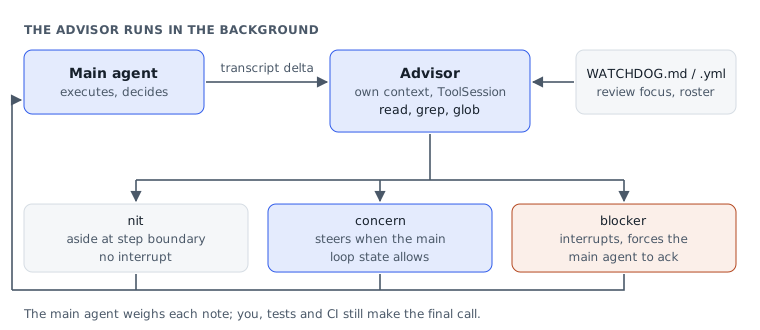
The three severities are the control part of this loop. They decide how feedback enters the main loop.
nit: Cleanup, simplification or a low-risk edge case. No interrupt. Batched into the transcript at the next step boundary.concern: A real risk, a wrong direction, a missing constraint or a suspicious API (Application Programming Interface). It can steer the work in progress.blocker: Continuing would waste effort or produce broken output. It can interrupt and force the main agent to acknowledge, even after the main agent has declared it is done.
If every issue blocks, speed collapses. If every issue is just a note, supervision has no force to stop a wrong direction that keeps burning tokens and editing files. What severity solves is when a judgment is allowed to change the pace of execution. That is harder than writing a good review prompt.
Opens when your account has subscriber access
This guide is for subscribers
Once your account has access, the full piece, the interactive visual and the agent call all open.
- Sign in or create a modernEngineer accountReading access belongs to your account email.
- Choose a plan on the pricing page1, 3 or 12 months, paid by VietQR bank transfer. Access opens about a minute after the money arrives.
- Or redeem a Facebook subscriber codePeople supporting the page on Facebook get an activation code by message each month.
Already a subscriber? Sign in to read.
Use this piece in your agent
Get an API keyCopy the text below and paste it into Claude Code, Codex or whichever agent you use. The agent reads the piece and checks it against the repo you have open.
Read "Advisor in OMP, Claude Code, and AgentKit: three kinds of second opinion" on modernEngineer and apply it to this repo.
1. Call the content_get tool of the modernengineer MCP server with locale "en", slug "advisor-claude-code-omp-agentkit". If the modernengineer MCP server is not connected, stop and walk me through connecting it from https://modernengineer.dev/en/mcp.
2. Summarize the main steps of the piece and point out which apply to this repo.
3. Propose concrete changes and ask me before editing any file.
Connect MCP in Claude Code (once)
claude mcp add --transport http modernengineer \
  https://api.modernengineer.dev/mcp \
--header "Authorization: Bearer <API key>"Reading the full piece over MCP needs an API key from a subscriber account or one that bought this guide. Without access, the agent only gets the opening.
- Version
- v1.0.0
- Updated
- 03/09/2026
- Licence
- Subscriber-only; redistribution prohibited
- Slug
- advisor-claude-code-omp-agentkit